Gift 24 – Second Chances

Son,

A few weeks ago your mom and I had several couples over for dinner.  We got talking about proposal stories and ended up going around the table, each couple sharing the story of their engagement.

I was hoping the conversation would change before it got to us because my proposal to Amanda wasn’t anything special.  To be honest, it was completely lame.  I’m not saying that proposals need to be grandiose complete with hot air balloon rides to Paris or anything, but I really didn’t do anything to make her special or even appreciated.

When the conversation came to me I said, “Um, well, I pretty much just asked.”

“You didn’t do anything?  Like did you even take Amanda out for dinner, or give her flowers or something?” a friend questioned.  “Nope.  Just asked,” I said a little bit embarrassed.  The awkwardness passed, though as the evening went on an idea began growing in my mind: who says you can’t propose a second time?

Last week we celebrated our second anniversary, and I’m pleased to say I had the chance to re-propose to the woman I love (I’m also pleased to say that she said yes :)).  This time I made sure to show her how thankful I am to have her in my life.

proposal

Here’s the point, son.  It is all too easy to become comfortable and complacent in the relationships that matter most in life.  I’m talking about one-word responses, thoughtless gifts given only because of a holiday, and even just monotone conversations that become the norm.  If you’re not careful, your relationship with family and friends will become crusty like food forgotten in the back of the refrigerator.

To quote the great philosopher Taylor Swift, “Life makes love work hard.”   Though I hate to say it, Taylor’s right.  Life happens, and loved ones can get pushed to the backseat pretty quickly.  A little thoughtfulness, creativity, and surprise can go a long way in keeping relationships healthy.  When I become robotic as a husband, son, or friend, I’ll often be gently shaken back to attentiveness by one of many kindhearted friends in my life who live what I’m talking about.  One friend and colleague writes an encouraging note to someone just about every single day.  He’s been doing this for over 8 years!

Right now is a good time to do something out of the ordinary to show appreciation for someone in your life.  So think, then do.  Right now.  Go out of your way to make a friend’s day, or take a second chance to repair something you should have done right the first time.  Just remember, son, you only get one opportunity to re-propose, so make it special.

Gift 23 – Prayer (III)

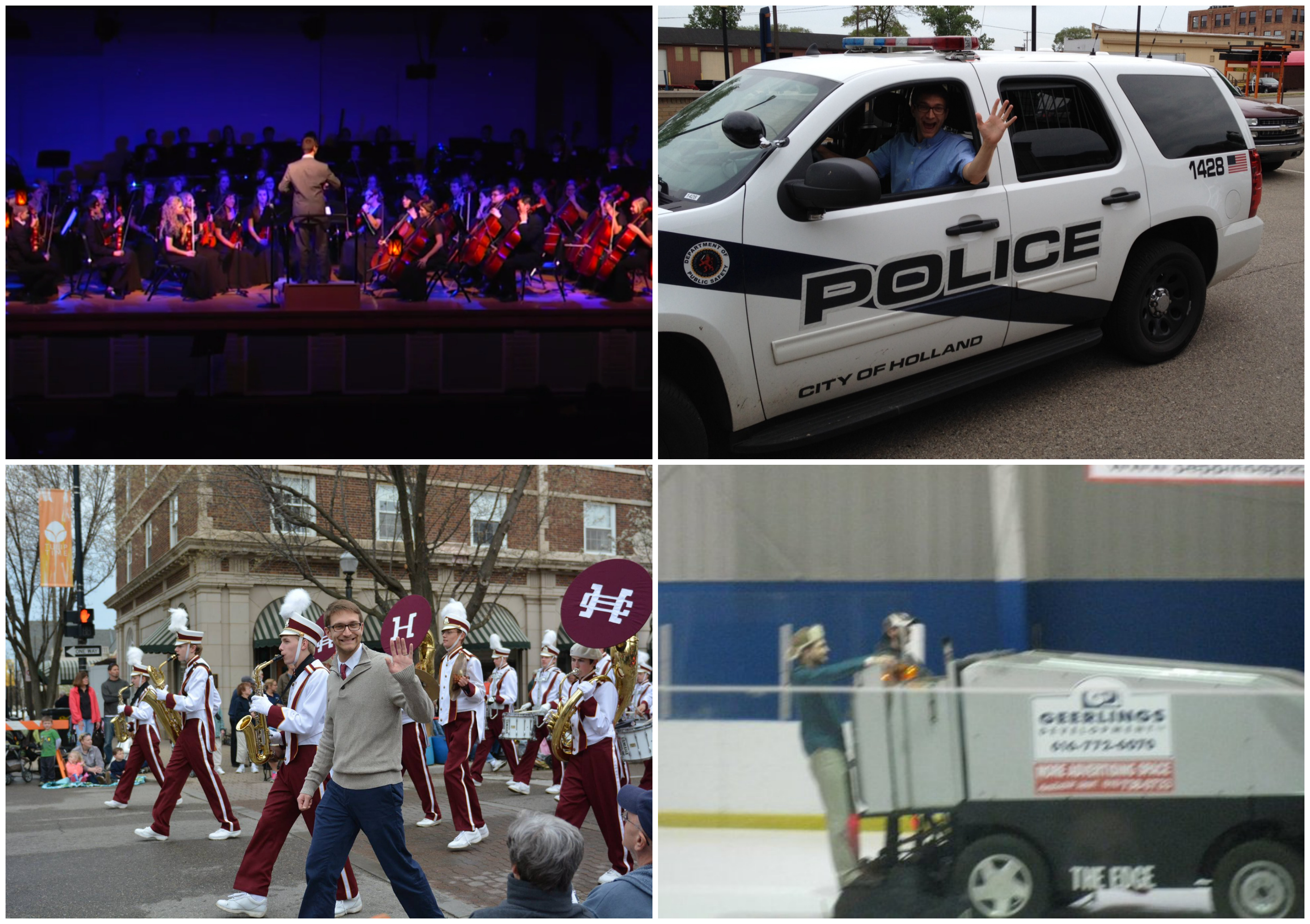
“Is there any chance I could direct an orchestra piece for the Fall Concert?” “Do you think I might be able to get my picture taken in the front seat of your police car, officer?”   “Would it be okay if I marched with the band for a parade?” “Can I ride on the Zamboni between periods of the hockey game?”

“Is there any chance I could direct an orchestra piece for the Fall Concert?”
“Do you think I might be able to get my picture taken in the front seat of your police car, officer?”
“Would it be okay if I marched with the band for a parade?”
“Can I ride on the Zamboni between periods of the hockey game?”

Son,

You might be wondering how I got to do the things shown in the pictures above.  Well, believe it or not, all I did was ask.  Yep…that was it.

If you look up everything that Jesus says about prayer in the Bible, you might be surprised to find (like I was) that he so often focuses on asking from God.

If you abide in me, and my words abide in you, ask whatever you wish, and it will be done for you.

I say to you: Ask and it will be given to you; seek and you will find; knock and the door will be opened to you. For everyone who asks receives; the one who seeks finds; and to the one who knocks, the door will be opened.  Which of you fathers, if your son asks fora fish, will give him a snake instead?  Or if he asks for an egg, will give him a scorpion?  If you then, though you are evil, know how to give good gifts to your children, how much more will your Father in heaven give the Holy Spirit to those who ask him!

Very truly I tell you, my Father will give you whatever you ask in my name. Until now you have not asked for anything in my name. Ask and you will receive, and your joy will be complete.

 Or what about the second half of the famous prayer that Jesus taught his disciples:

Give us today our daily bread /  Forgive our debts, as we forgive our debtors  /  Lead us not into temptation  /  Deliver us from the evil one.

 So much asking!

At first, all this asking might make a person a little uncomfortable.  We’ve all been told that God isn’t some divine Santa Claus who exists to satisfy our desires, so what’s going on?  A few things to notice…

  • First of all, if you are someone who loves and follows Jesus, your desires will be increasingly shaped by God’s heart.  Put bluntly: a maturing Christian isn’t asking God for a pony.  James writes, “You do not have because you do not ask God.  When you ask, you do not receive, because you ask with wrong motives, that you may spend what you get on your pleasures.”   A good question to ask is, “Is my life about God’s kingdom or my own?”  That will help determine whether your prayers are about God’s kingdom or your own.  The more you are shaped by the revelation of God’s Heart in your life (through God’s Word, the Holy Spirit, the Church), the more you will care like God’s heart cares.   As this happens, God says ask away!  Asking becomes powerful when the heart of Christ is alive in the body of Christ.
  • Prayer changes the pray-er.  Praying can actually wake up our desires and can be a catalyst for action.  Those who don’t care don’t ask.  And those who care, ask, and care more with each asking.  Perhaps Jesus’ consistent invitations to ask are his pleadings with us to care and to act!  Pray for your enemy and you may start caring about reconciliation.  Pray for the hungry and you may start caring that they have food to eat.  Pray for your wife and you may be moved to be a source of joy and encouragement for her.   In this mysterious way God often answers our prayers through the praying, because prayer is not only a reflection of your heart but also a directing of it.  As Eugene Peterson says, “We become what we are called to be by praying.”
  • Maybe the most important thing to realize is that the asking kind of prayer is an act of trust, dependence, and worship.  No one who is self-sufficient or self-reliant asks for anything, but the person who knows the good character of God relies on him like the branches of a fruit tree depend upon the trunk—and so they ask.  Making requests in prayer is acknowledging God’s generosity, God’s unlimited abundance, God’s ability to provide, and God’s loving heart towards his children.  The heart that does not ask does not yet know God as He wants to be known.

Son, I am convinced that God actually wants his people to ask more than we do, not less.  Though it was uncomfortable at first, I’ve gotten in the habit of making requests to God on a regular basis.  Just as I was surprised by what came of asking a police officer to sit in his car, or asking to march with the marching band, I’ve also been astonished by all that comes from making requests in prayer.

So ask already!

Here are some suggestions:

–       For eyes to see and ears to hear.

–       For opportunities to serve (the funny thing is, asking this will makes you aware of all the opportunities to serve that have always been around you).

–       For joy and compassion.

–       For wisdom and wonder.

–       That God’s Word would become a delight, like the author of Psalm 119.

–        For encouragement and strength for struggling friends and family.

–       Good things for your enemies.

–       Hope for young people wrestling depression.

–       For a tight reign on your tongue (words are powerful!).

Gift 21 – Prayer (I)

“Sometimes I wonder if God is secretly thinking, ‘Dear Child, you are welcome for this day and I already blessed the food. Can we talk about something else now?'” – Anonymous

I once saw a skit that followed a day in the life of a young Christian. Throughout the day—when he got out of bed, before meals, before bed, etc.—the man got on his knees to pray. Every time this happened Jesus would enter and stand next to the young man, eager and excited to talk. But the kneeling man never noticed Jesus standing right next to him. Why not? He was too busy praying, parroting words and phrases that had long since lost their meaning. Jesus tried getting the Christian’s attention and faithfully appeared each time the man knelt to pray, but they never really connected or even truly communicated.

Is this prayer? I think many people would guiltily agree that this pretty much sums up what prayer looks like in their actual lives. We know prayer is meant to be wonderful, powerful, and transformative, but there is a massive divide between theory and practice. Imagine being married but only ever communicating with your spouse via text. There would be little life in the relationship because all interactions would be limited, simple, one-dimensional, peripheral, and brief. This is a picture of the sad reality many Christians experience (or don’t) when it comes to communicating with God. Thinking back on my own prayer journey you would have thought I was an auctioneer the way I “talked” to God:

Dear God thank you for this day please keep grandma and grandpa safe as they fly to Florida and bless this food to my body in Jesus’ name amen.

But son, I want you to know there is so much more.

To be honest, I don’t really have any awesome advice to get you from point A to B in what might be called your “prayer life”. I don’t have 5 simple steps to achieving deeper communication with God or 10 helpful hints to get you praying like Mother Teresa. Because really, there is no such thing as “improving your prayer life” apart from cultivating and nurturing a dynamic relationship with God. Like all other relationships, the depth and tone of conversation is merely a reflection of the relationship itself. Listen in on a conversation between teenagers on a first date—the communication will probably be forced and awkward because the relationship is just beginning.

This means that prayer is more than folding your hands and closing your eyes before you eat; it is an awareness that the place where you’re standing is holy ground and you had better take off your sandals, it is an attentiveness to the fellowship of the Spirit even on a mundane Tuesday, it is a responsiveness to the company of the Living God who seeks to take up residence in your everyday life, it is what Brother Lawrence called “The practice the presence of God.” Walking this path is like walking in the very heart of God.

And yes, son, like all other Christian practices prayer often requires discipline before it becomes delight, but you must know that the heart of prayer is accepting Christ’s own blood as the invitation to enter the sacred fellowship of the Trinity, the Holy Wellspring of Joy and Life from which Creation sprang into existence. When you understand the gravity of this gift you may very well only be able to pray, “Dear God!” But when you say those two little words, and mean them both with all your heart, you will have learned what it means to pray.

Gift 20 – The Truth about Fiction

photo (6)

Believe it or not, this lit. enthusiast, English major, and all around word-lover used to utterly detest reading.

In middle school I somehow almost always coincidentally chose books to “read” that had been made into movies. The teacher would see the title I’d picked and say, “I think that story was made into a movie a few years ago. You might enjoy watching it when you’ve finished the book.”

“Oh Really?” I would say, “I didn’t know that. I’ll have to see if I can rent it when I’m done reading.” I knew this was a dishonest practice, but I had no other way of passing the monthly Accelerated Reader tests.

But everything changed when I checked out The Wonderful Wizard of Oz from the school library. It was the natural choice since I’d already seen the movie adaptation at my grandparent’s house, though when a friend told me about a few variances, I decided to skim the first few pages just to cover my bases.

ozThen it happened: I went to Oz. I didn’t mean to, but I ended up getting hooked and actually finished the book (“It was kinda like watching a movie in my head,” I told my flabbergasted friends). I found out that L. Frank Baum had actually written 13 other Oz adventures, so I bought and read them all.

This was just the beginning of my love for fiction, and for reading in general. Over ten years later, I am convinced that books such as The Wonderful Wizard of Oz impact young people in countless positive ways and contribute to a person’s sense of creativity, wonder, and depth. Every once and a while I meet a fiction critic who doesn’t have time to waste on “silly stories that aren’t even true”, and while I have about a hundred reasons why reading fiction is an unequivocally good and wholesome activity, I want to share just one with you now:

The very best fictional stories are true. Really.

You see, there is a difference between something that is truthful and something that is factual. Many Eastern cultures have historically appreciated this difference when it comes to storytelling. Take, for example, the story of the Boy Who Cried Wolf. A westerner will tell you that the story is not true. Why not? Because it didn’t really happen. But tell the same story to someone from a story-centric society and they’ll likely tell you that it is in fact true. Why? Because it is true, isn’t it? The deterioration of one’s integrity is very serious business. Every time you break your word the value of your word decreases. Or, as Aesop famously said, “Nobody believes a liar…even when he is telling the truth!” These things are true, making the Boy Who Cried Wolf a story that tells truth, though not necessarily through fact. This is an exceptionally significant distinction to make, and is, in my opinion, the very best reason to read fiction.

Books such as the Harry Potter series, The Lord of the Rings, and The Chronicles of Narnia are stories that tell the truth. Friendship is more valuable than power. There is more to people than mere appearances. Humility and self-sacrifice is greater than superiority and self-importance. Things are not the most important things. Courage in the face of overwhelming odds does make a difference. Love is stronger than death. The light does shine in the darkness and the darkness will never overcome it.

There is great and nourishing magic in stories that tell the truth—even when the stories aren’t comprised of facts. It is worth noting that Jesus himself dealt almost exclusively in fiction to communicate truth to his audiences (Matt. 13:34). “There was a man who had two sons. The younger son came to his father and demanded his share of the inheritance…” “Suppose one of you has 100 sheep and one of them runs away…” “There was a woman with ten silver coins…” “A wealthy man was preparing a great feast…”

Clearly there is more to fiction than meets the eye. In fact, In Mark 4 Jesus explains to his disciples that the very reason he speaks in story is so that only few will understand. It is as though his stories are invitations beckoning the true in heart to follow where he leads. Because bookJesus, in his unexpected, seemingly foolish, upside down way of doing things still leads to a cross, and it will be those whose eyes have been shaped by the truth found in fiction who will be the first to recognize and believe that the gardener outside the tomb is really the resurrected Son of God.

Gift 19 – Be the Bigger Man

“Courage is what it takes to stand up and speak; courage is also what it takes to sit down and listen.” – Winston Churchill

I’ve learned that being the bigger man almost always means being the smaller man.

Culture says that manliness = bravado. Never back down, never surrender. Win at all cost. Get even. Give them a piece of your mind. Have the last laugh.

But son, true strength is not shown in domination, destruction, power, or supremacy. I’m reminded of this in the movie 42 when Jackie Robinson asks Brach Rickey, “You want a player who doesn’t have the guts to fight back?” and Rickey responds, “No. I want a player who’s got the guts not to fight back.”

Though this kind of strength often looks like weakness, it contains the secret power of restoration, healing, and change. This kind of strength has the power to bury cycles of revenge that might otherwise go on forever.

When it comes to unproductive arguments and destructive competitions, this means raising the white flag. When it comes to foolish feuds at school, in the workplace, at church, and at home, this means apologizing in order to restore relationships. When it comes to battles of pride and ego, it means humbling yourself to step out of the ring.

When being the bigger man feels impossible, remember that true strength is having the power to call twelve legions of angels to your side, but instead staying quiet while the proud line up and spit in your face one at a time. Remember, too, that this kind of death contains resurrection power.

Live in this strength and you’ll know the power of Jesus, the biggest smallest man who ever lived.

My First Tea Party

I had the wonderful privilege of speaking at Lansing Christian’s Mother Daughter Tea. When preparing, I decided that since I am not a mother or a daughter (surprise, surprise) I would tea-party-previewwrite a letter for a daughter I might have someday that I could read at the event. The following words are not just for my future daughter, but also for these terrific young ladies who have so much ahead of them. Congratulations!

Dear Daughter,

There are plenty of ways in which men and women aren’t all that different. When it comes to brokenness, I find that all people have more in common than we sometimes pretend. Though we often face different cultural demands, and combat distinct styles of social pressure, men and women alike are haunted by the same question. The question directing all decisions of what to buy, how to dress, how to talk and act and pretend, the question I’m asking as I try my hair one way then another, or as dress like this Monday and then like this on Tuesday, or even as I ponder future decisions of what to drive, where to live, what to do with my life; the unanswered question that shrewdly influences almost every single thing I do is this: WHO AM I?

I have the incurable tendency of going back to my insecurities day after day. Each morning I am inclined to crawl into my old skin of self-consciousness, self-centeredness, and even self-contempt. This fragility I know all too intimately manifest in different ways in different people. For some it means constant mirror checking, for others it looks like the frantic pursuit of success, others manage the hurt by going time and time again to others for confirmation, endorsement, validation of the lie that I have it all together, that I am what I appear to be. But the truth is, I am wounded. I am broken. I am looking for something and don’t know where to find it.

Oh but there is a remedy.

Do you remember the story of the Greek warrior Achilles? He was nearly invincible in battle. No one could scratch him from the hairs on the top of his head to the skin on the tips of his toes…except of course, for that vulnerable heel. This was his one shortcoming—the very weakness that led to his downfall when an arrow almost aimlessly struck him in just the right place. But do you remember why the heel was the weakness of Achilles? The story goes that when he was just a baby, Achilles’ mother, dipped her son into the magical River Styx to make him immortal. The only part of him that was not touched by the water was, of course, the heel by which his mother held him.

Daughter, I know of a river that makes old things new, that makes impossibly broken things whole again. There is a river that washes clean and restores life. This river is the love of God. Like Achilles, those whose hearts are bathed in the rush of this water will be strong, while those places in your life that go untouched by the powerful current will sprout weakness and insecurity. The most important thing I can say to you is this: immerse yourself in this river every day. Submerge, plunge, cannon ball into it so that every inch of your soul is dripping with God’s love for you. Soak in this love and it will become your identity. Soon it will well up and spill over, flowing through you making rivers in the wasteland of this broken world.

So never let it out of your sight. Take your coffee with it each morning. Christ’s perfect love drives out fear, it drives out jealousy, it drives out distrust, envy, vanity, judgmental thoughts, poor attitudes, self-absorbedness. Perfect love drives out impatience, gossip, the fear of what others think, doubts about God’s heart, terror of the past, worries of the future. There may be many locked doors in your heart, but God’s perfect “I love you” is the Master Key that unlocks them all and lets in the fresh air of freedom. God’s love is so effective, so powerful, so practical, and so incredibly applicable because it always addresses the heart, the deeper reasons behind our actions. Love changes everything. In fact, I have found that the extent to which I still sin is an exact measurement of the extent to which I have yet to receive God’s love.

Sin germinates in hearts that distrust God’s love. You see the first sin wasn’t eating a fruit in the garden of Eden, it was doubting the loving trustworthiness of God! The serpent’s whole victory was in distorting Eve’s perception of God’s heart. The same is true of the second sin. Yes, Cain murdered his brother Abel, but only after he’d been corrupted by jealousy because Abel had offered a better sacrifice. And why hadn’t Cain offered an acceptable sacrifice? Why did he hold back? Could it be that he didn’t trust the good heart of God? That he couldn’t offer God the best of his crops for fear that God’s provision wouldn’t be enough? Could it be that in his heart of hearts Cain refused to believe that God is love?

You see, the heart that trusts this love despite the Enemy’s attempt to sell you a lie, that heart will be made perfect in love and will have no room for evil. As one authors says, “Nothing you will ever do could make God love you more than he does right now: not greater achievement, not greater beauty, not wider recognition, not even greater levels of spirituality and obedience. Nothing you have ever done could make God love you any less: not any sin, not any failure, not any guilt, not any regret.”

My daughter, put plainly, you are stuck in the love of God. And though your disbelieving heart will sometimes contend that you are unlovable, and though you may, in low times, be so intimately aware of your shortcomings—things you’ve thought, things you’ve done, things you’ve been—you must remember that these evidences have been tossed from God’s courthouse, that the verdict has been decided and the jury is unanimous, the judge has already slammed the gavel and there will be no further argument: you are loved.

Clinging to this love will be your great strength. For out of the soil of God’s perfect love grows confidence, kindness, joy, true beauty, life, and all other good things.

I know who you are. God has given me the privilege of experiencing just a little bit of his heart for you. And you, my dear daughter, are loved.

Gift 18 – Relatively Speaking

Einstein was right: everything is relative.

You see, I’ve always thought of Piper as a wild and bad dog. I think this when, out of all the magazines, he finds and destroys the one called “Family Dog” as though he knows our secret plans to civilize him and won’t have any of it. Or when I hold his face by the hole in the wall that he’s eaten for the third time and sternly say, “bad dog!” while he wags his tail. Or when I come home from work to find him sitting in my chair and he looks at me insolently as if to say, “Um, can I help you?”
1969340_10152327876589766_52893528_n
I used to think these things about Piper, that is until I saw a picture my friend posted on facebook (right). My friend’s dog saw a squirrel outside, and knowing the shortest distance between two points is a straight line, bolted right through the window to catch his quarry. Instead of getting the squirrel he got 9 stiches in his nose.

After seeing this picture I thought to myself, Piper isn’t so bad after all. Because, of course, the badness of dogs is relative.

Everything is relative if you think about it.

You might be 6’2, but you still won’t feel tall standing next to Shaq.

You might consider yourself fast, but not when racing Usain Bolt.

You might think you’re rich, but not when walking in Bill Gate’s neighborhood. On the other hand, you might think you’re poor, but probably not when visiting a developing nation. It’s all relative.

I think this is why New Testament authors constantly remind early Christians to keep their eyes on Jesus. We humans have the tendency to complain—this happens when you compare yourself with someone on the more “desirable” end of the spectrum; when you see that you’re not as popular as _____________, or as well paid as ______________, or as talented as _____________, or as clearly understood as ______________. Poisons such as jealousy, envy, gossip, scorn, discontentment, and dissatisfaction all bubble up from this toxic spring of comparison.

But, in reminding believers of Jesus’ own experiences, the Apostle Paul points us all the way to the other end of the spectrum. Look at Jesus, he says. You might want to complain about the crappy day you’re having, but when you run into a friend whose house recently burned down, you’d feel pretty stupid grumbling about a broken dishwasher. Likewise, any unfair, or difficult, or upsetting situation I find myself in quickly seems more than bearable in comparison with all that Jesus endured on my behalf.

I often catch myself saying things like, “But that’s not fair!” “I don’t deserve this!” “This is ridiculous!” Even in marriage I am often all too concerned with what I think is “fair.” “I did the dishes last night, it’s your turn.” “You want me to run to Sam’s Club? I was at work all day!” etc. And yet, my logic becomes embarrassing and laughable when I consider Jesus surrendering his rights—all that he really did deserve—to pursue a cross on our behalf. What complaints slipped from his lips as he surrendered to the Father’s will? Did he so much as grumble as He set his face toward Jerusalem? Or as he was mocked and spat upon? Or as he was brutally murdered in the greatest act of injustice the world has ever seen?

And here I am complaining…about Sam’s Club?

The purpose of looking to Jesus’ suffering isn’t so that you feel like a horrible person whenever you want to complain. Nor is it the purpose to trivialize the truly difficult and sorrowful things going on in our lives—not at all. The point is to understand the depth of Christ’s selfless character and to be shaped by His good heart, remembering that we’ve actually been given more than we deserve.

Do this, son, and instead of being filled with jealousy or discontentment you will come alive with gratitude, joy, and a deeper love for Christ.

Gift 17 – Hibernal Man Fires and the Like

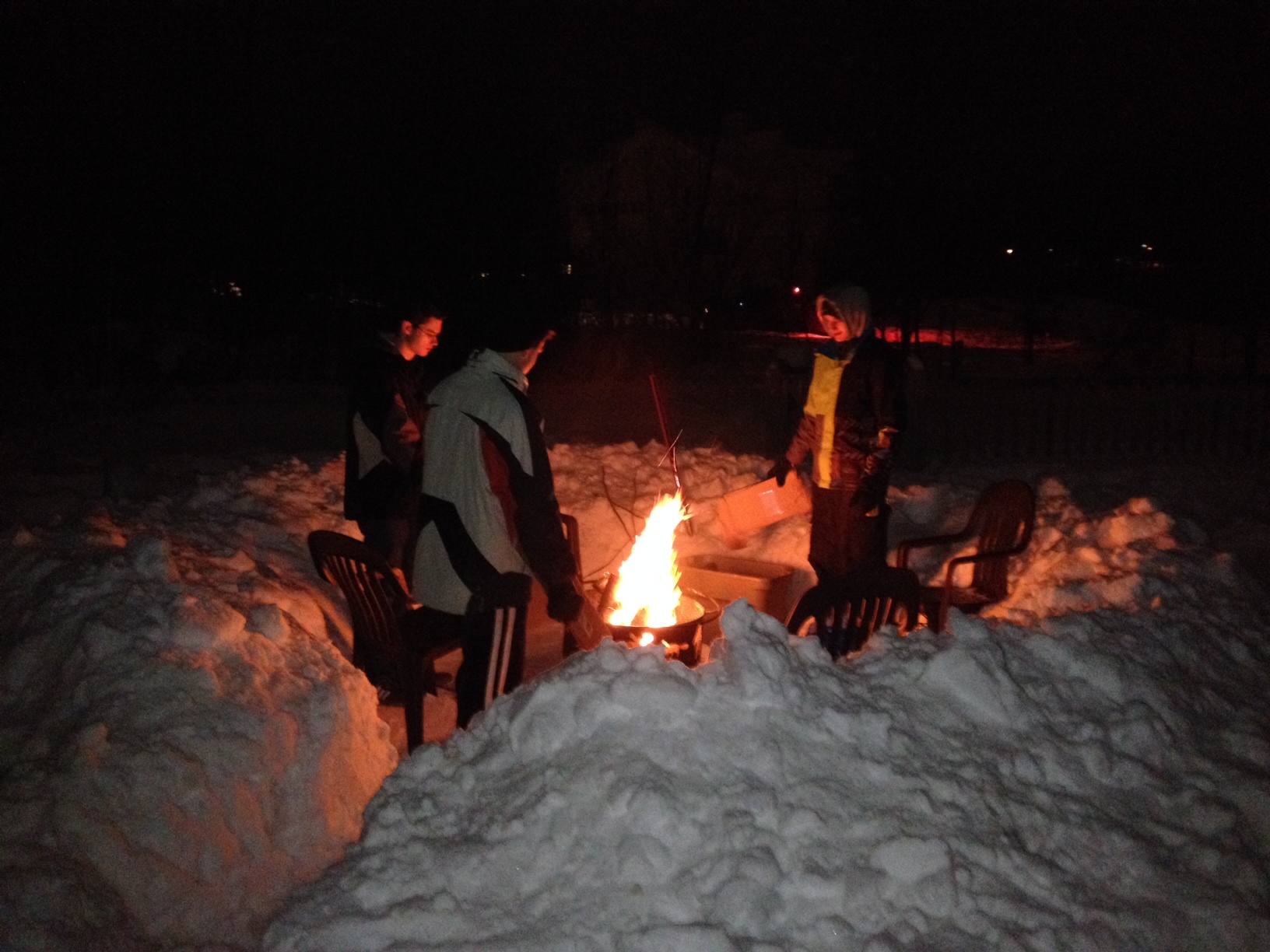
A “Hibernal Man Fire”—That’s what we called it.

Ingredients are as follows:

– 1 large circler pit dug out of the 3 feet of snow in our backyard.

– 1 bonfire in the middle of the clearing.

– 5 guys bundled in hats and coats gathered around the fire to read classic short stories.

– 1 full moon.

The guys and I had the idea for this “Hibernal Man Fire” while sitting in the library at school. We had all been feeling a little stir-crazy as the bitter winter months drudged slowly on, so we decided to do something about it. Yes, some good stories told around a fire in defiance of February’s crappiness was exactly what was needed (Plus, who doesn’t love fire any time of the year?).

It is random outbursts of craziness and life such as our “Hibernal Man Fire” that turn into wonderful traditions. In fact, we’re hoping to have another short story/bonfire combo soon (stories on deck: “The Machine that Won the War”; “The Most Dangerous Game”; “By the Waters of Babylon”; “Leiningen vs. The Ants”; “Lamb to the Slaughter”; “The Man by the Window.”)

Traditions are so important because they are always relational—they are things we do together, usually to celebrate, or to remember, or to simply to keep life from becoming mundane. And frankly, our culture stinks at them. What do we do to celebrate important milestones?… hmm…get wasted on our 21st birthday?

Oh. Great.

Son, it’s up to us to create traditions that nurture good things, admirable things, life-giving things, Dangeruss things. Here are a few ideas…

1. A 15-year-old Adventure. This means that when you or any of your siblings turn 15, we’ll plan a weeklong trip in the wild. Maybe we’ll canoe down Michigan’s Jordan River, or hike the Porcupine jordanMountains in the Upper Peninsula, or explore South Manitou Island, but wherever we end up going you can count on being challenged—and you might just learn a thing or two about the outdoors (and maybe about yourself, too). We’ll bring a book (preferably one of the Chronicles of Narnia ☺) to read around the fire at night before crawling into our really cool Cabelas Alaskan Guide tent (which I’ve already purchased in anticipation of our camping adventures).

2. Birthday gifts. This may sound fairly typical, but let me explain. I learned a few years ago that expecting great gifts is a surefire way to have a disappointing and/or insignificant birthday. It is way more fun to give awesome gifts to the people you care about (or to complete strangers…either way). So, while your mom and I will still probably give you a present or two, your main gift will be $100 to spend any way you choose, as long as it’s for other people. Be creative. Be generous. Have fun. (But be careful, this is how our family ended up with our crazy dog, Piper).

3. It’s-Not-About-You Trip. I heard about my principal’s family doing this and definitely want to copy their idea. When you turn a certain age, your mom and I want to take you on a mission trip to spend a week serving others. It’s easy for young teens to think that the world revolves around them…but it doesn’t. In fact, your life isn’t even about you. Seeing the conditions in which so many live around the world will challenge you to examine our culture’s concepts of entitlement, materialism, and self-centeredness.

4. Cousin Olympics. Ever since we had our first Cousin Olympics almost ten years ago I’ve been excited to plan this annual extravaganza for the next generation. We’ll spend three days at grandpa and grandma’s competing in all kinds of team activities such as archery, board games, relay races, swimming, dodgeball, kayak races, and many more. Traditions like this contribute to strong and healthy friendships between family members—friendships that last a lifetime.

5. Rite of Passage. Your uncles and I have been talking about having some kind of ceremony when you reach a certain age. Here’s the general plan: you’ll have about three hours to round up as many downed limbs from the woods as possible to collect in a giant pile. When time’s up, we’ll light the mound on fire (safely, of course ☺) and spend the evening gathered around sharing stories and advice. Each adult will tell one “success” story and one “failure” story as a way of offering guidance and advice to the younger one(s). At the end of the night we’ll give a blessing and welcome the new adult into the tribe.

There are so many other great traditions I want to start with our family and friends that I don’t have space to write them all down here (Note: Please feel free to comment below with traditions you currently have or hope to start in the future).

Our culture has lost its sense of ritual; we no longer think of identity in terms of community, but only as individuals. Creating traditions is a way of bringing us back together, of shaping a culture that values people more than things, and of making memories with the people we love. A good tradition can be a mini-revolution of life and friendship, and all the other good things in life worth coming together to celebrate.

Gift 16 – Chasing Bigfoot

My friends and I are big fans of Finding Bigfoot, the highly acclaimed TV series in which a team of four professional “Squatch Hunters” tries to track down the legendary Bigfoot. On this show that has become popular due to its ridiculousness, the team utilizes thousands of dollars worth of high-tech night vision equipment along with their natural squatch sense to track down “evidence” in hopes of someday proving the existence of Bigfoot.

On one particular episode, the team’s leader and founder of BRFO (Bigfoot Research Field Organization—naturally), Matt Moneymaker stated that he has spent the last 25 years of his life looking for this elusive (or much more likely, non-existent) creature.

At this point my friends and I erupted into laughter. “Wait…did he just say he’s spent the last 25 years looking for Bigfoot? Imagine putting that on a job application!”

Photo credit: Image via Josh Crockett, http://monsterfaces.weebly.com

Photo credit: Image via Josh Crockett, http://monsterfaces.weebly.com

25 years. Wow. That’s a long time to be looking for anything, let alone a mythical ape-like mammal. In disbelief I said to my friends, “Imagine how hilariously tragic it’s going to be when this guy stand before Jesus, and Jesus says, ‘So Matt, how did you spend the life I gave you?’ and Matt replies, ‘Uh…Well, I spent my youth, my money, my passion, my energy, and a total of 25 years of my life looking for Bigfoot.” Again, we burst into laughter.

But after a few minutes I was struck by a convicting thought: Is whatever I’m looking for any less ridiculous? When it comes down to it, is running after wealth, or popularity, or pleasure, or fame, or comfort, or success any less absurd than running after Bigfoot?

Jesus said, “Whoever wants to save their life will lose it, but whoever loses their life for me will find it.”

In other words, in an attempt to make our lives significant by becoming rich, or beautiful, or well-liked, we’re actually on an endless and meaningless search for something we will never find. I look at Matt Moneymaker and think ‘what a silly and ridiculous way to spend your life!’ but is not Jesus saying the very same thing to those of us pursuing anything other than Him and His Kingdom? Think of all the time, energy, and resources that Matt Moneymaker has expended to find a creature that probably doesn’t even exist! And yet, perhaps it will be just as embarrassing to tell Jesus about all the time, energy, and resources I expended on my search to find significance and worth apart from Him. Imagine your hopeful grin as you stand before Jesus with a nice car, or a pile of money, or a thousand facebook friends, or whatever else we might chase after and realizing that you missed the point—you wasted your life.

And here’s the thing about the show Finding Bigfoot: they never actually find him (a more appropriate title would be Looking For Bigfoot). According to Jesus, the same goes for looking to save your life—you’ll never actually do it. The only way to save your life is in losing it to the One who died to save it.

Businesses and other organizations create mission statements as a way of defining and illuminating just what it is they are running after. This statement clarifies what the group is and what it’s all about, and also holds the organization accountable for everything that doesn’t fall under the umbrella of the mission. Jesus helps define the mission statement for the people of God when he is asked about the greatest commandment. He says, “’Love the Lord your God with all your heart and with all your soul and with all your mind.’ This is the first and greatest commandment. And the second is like it: ‘Love your neighbor as yourself.’”

Ask yourself, son, Is this what I’m chasing after today?

Gift 15 – An Oriented Life

When you think of praying in a certain direction, you probably first think of the Islamic tradition of praying toward Mecca in the East, but actually, the Hebrew Bible tells of a more ancient “directional prayer.” 1 Kings 8 talks of people praying toward the newly built temple of the LORD in Jerusalem. But why? Even Solomon himself, the king who built the temple, knew that God is too great to be confined in a single place (“But will God really dwell on earth? The heavens, even the highest heaven, cannot contain you. How much less this temple I have built!”). So why pray facing it?

Perhaps facing a direction in prayer is a physical way of orienting our lives towards something other than ourselves. Facing the Temple was a bodily reminder that one’s life matters only in relation to God’s, like the long hand of a clock orbiting around a center point that gives it its rhythm and meaning; without which nothing makes sense.

I seem to need constant reminders that I am not the center. You’d think that being in ministry is a sure sign of a person’s life oriented toward God, but come to find out, it’s trickier than you’d think. In fact, ministry can all too easily become another means of orienting towards oneself—this happens when a person begins to love the talking more than the God one is talking about. It is a question I have to keep asking: What is the orientation of my life? What am I facing? What am I living for? What gives me purpose, meaning, and satisfaction?

Son, better learn early on that you are not the center. You are not the reason why all other things exist, but you know what, that’s actually good news. Life works photo (2)best when you know that you exist only in relation to someone else. Like the lilies on our counter that move to face the sun throughout the day, I pray you too orient yourself toward the Source of Sustenance. My hope is for you to become a man who is directionally dependent on the Holy Presence of the Living God; that you aim your life wherever he is found.